Keep
Give the object a place in your collection.
 Selected work
Game design case study
A home full of belongings.
A story in what remains.
Exploring grief and memory through the quiet act of deciding what to do with the things people leave behind.
Open Figma prototype ↗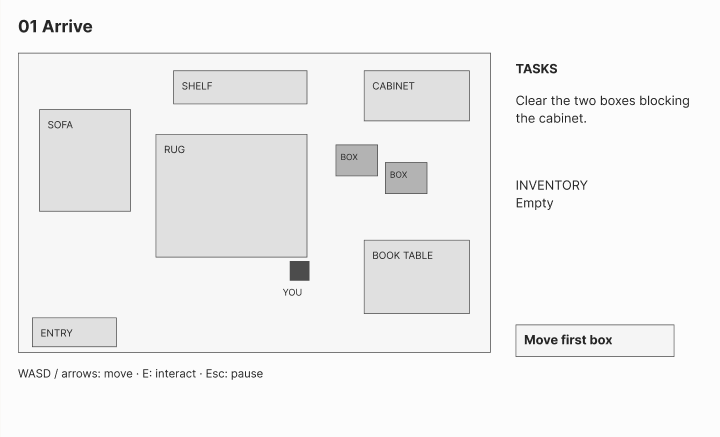
01 / Overview & design challenge
What We Keep explores grief, memory, and the objects people leave behind. The player returns to a familiar home, clears clutter, uncovers meaningful belongings, and decides what deserves a place in their life.
The design challenge is to connect practical actions with emotional reflection. Organizing a room can have a clear completion state; grief cannot. The home becomes easier to navigate without implying that its occupant has finished mourning.
The intended audience is older teens and adults who enjoy narrative adventures, environmental exploration, cozy organization games, and light puzzles. This is a proposed audience, rather than a measured market segment. The GDD uses Unpacking and Gone Home as reference points for storytelling through possessions and exploration.
02 / Design goals & core loop
The goals are to make exploration purposeful, let household objects carry the story, and give players control over their pace. Progress is expressed through the environment and object destinations, with no score, timer, or preferred emotional response.
03 / Environmental puzzles & player agency
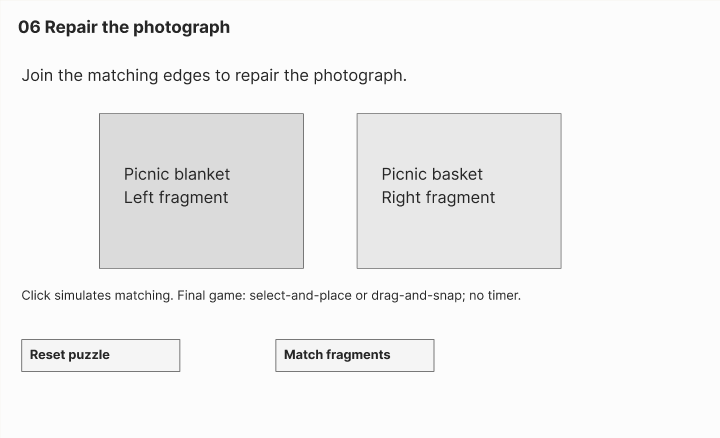
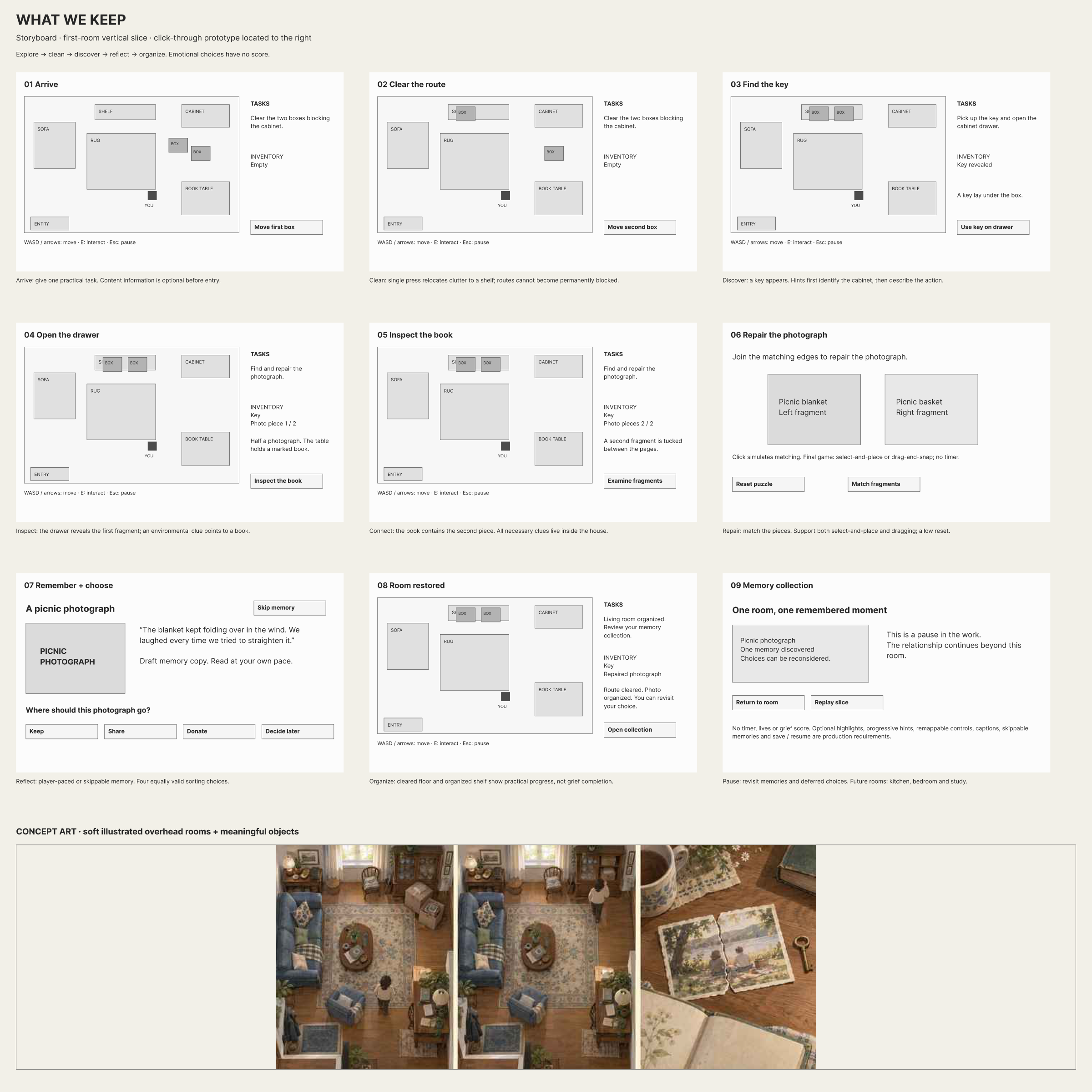
The living-room sequence connects two boxes, a hidden key, a cabinet drawer, a book, and a torn photograph. Clearing an obstruction reveals an object that changes what the player can inspect next. Repairing the photograph provides a concrete puzzle goal before an open-ended decision.
The original storyboard uses click-through actions to demonstrate this sequence. Documented revisions explore neutral inspection labels, either-order fragment discovery, progressive hints, and a more hands-on photograph puzzle with a simpler alternative. These are design iterations; the Figma flow does not establish finished movement or puzzle systems.
The revised puzzle design proposes five photograph pieces, with a simpler two-piece alternative. Planned game controls are WASD or arrow keys to move, E to interact, and Escape to pause; the current Figma prototype simulates actions through clickable buttons.
04 / Narrative & emotionally meaningful choices
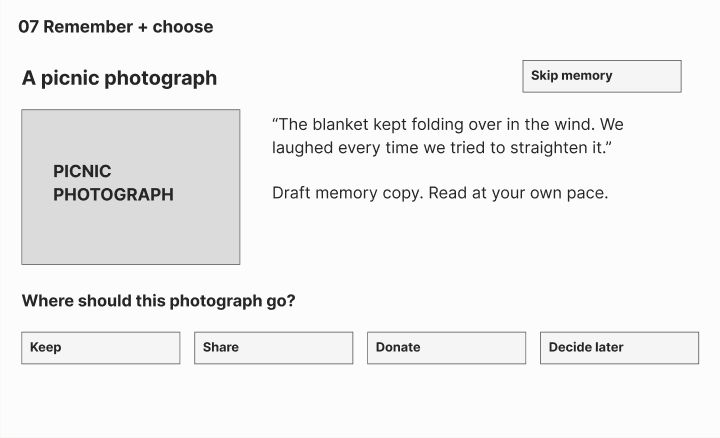
Short memories and ordinary household details invite the player to interpret the absent person's life. Grief can include an unresolved relationship, an imagined future, or experiences that never happened. The writing leaves room for that complexity.
Give the object a place in your collection.
Let someone else carry part of its story.
Allow the belonging to have another use.
Set it aside without forcing closure.
All four choices advance the practical task. The documented narrative revisions give Share a named recipient, Ren, and explore more specific memory details and distinct acknowledgements. No choice earns a better grief outcome.
05 / Figma storyboard & prototype
These images come directly from the existing Figma project. The schematic storyboard communicates room layout, object states, photograph repair, and the transition from a memory to a sorting decision. It represents prototype design, rather than final game art.
06 / Evaluation & documented iterations
The Sai and Lisa evaluations were simulated virtual playtests. They are documented design rehearsals, not independent human-user testing. Their feedback informs design hypotheses; it does not establish measured usability or emotional impact.
The Lisa scenario emphasizes active problem-solving and visible progress. The Sai scenario emphasizes narrative context, inference, and reflection. The documentation links their feedback to proposed revisions and revised screens, while noting where changes lack an isolated retest.
| Documented concern | Design response | Purpose |
|---|---|---|
| Action labels gave away solutions. | Neutral object inspection and less revealing labels. | Preserve inference while orienting the player. |
| Searches and object states lacked useful feedback. | Household descriptions, clearer inventory and open-drawer states. | Make exploration and practical progress legible. |
| Photograph repair offered too little participation. | A hands-on assembly proposal with a simpler option. | Give the discovery an active puzzle moment. |
| Share had no clear recipient. | Introduce Ren and explain the destination. | Make an emotional choice concrete. |
| Skipped memories were difficult to revisit. | A keepsake journal and clearer return paths. | Respect pacing and later reflection. |
These records support a direction for further development. They do not demonstrate that every revision is implemented in the current Figma flow. Direct evaluation with unfamiliar human participants remains a next step.
The Week 7 report records twelve iteration cycles for each simulated perspective. Lisa’s sequence emphasizes active searching, visible object states, and puzzle participation; Sai’s emphasizes narrative orientation, either-order discovery, tiered hints, and revisitable memories. Repeated exposure affected familiarity, and individual changes were not always retested separately. The records therefore guide further design without establishing comparative performance or usability gains.
07 / Accessibility & player experience
The prototype and design notes prioritize untimed interactions, optional memories, nonjudgmental choices, and progressive assistance. Written labels paired with symbols aim to reduce reliance on color alone.
Production considerations include adjustable text, contrast options, remappable controls, captions and visual equivalents for essential audio, keyboard alternatives to dragging, and save-and-resume support. These require implementation and validation. The click-through simulates movement, and its pause screen states that progress is not saved after closing.
The emotional experience also needs care: optional content information, player-paced text, the ability to skip and revisit memories, and deferred decisions help players choose how closely to engage with loss.
08 / Development status & next steps
The current deliverable is a Figma storyboard and click-through prototype supported by design documentation and simulated evaluation records. It is not a finished or released game, and no Unity implementation is claimed.
Production acknowledgement: Asset production is AI-assisted. Prototype visuals and illustrative assets should be understood as development material; this case study does not claim independently hand-drawn artwork.
Design documentation / October 2026
The final Unit 8 GDD brings together the audience and rationale, gameplay rules, narrative direction, balancing proposals, accessibility plans, and critical reflection. The Week 7 report connects the living-room revisions to documented feedback and prototype images.
These course documents are preserved as submitted. Their session descriptions should be read alongside the evaluation method above: Sai and Lisa represent simulated virtual playtests, and the logs do not establish independent human-user findings. “Final submission” refers to the course document; the game remains in development.