
Game design · narrative exploration · September 2026
Roots Beneath Neon
Making memory something the player discovers, rather than something the story explains.
Desktop keyboard required. First load downloads approximately 181 MB. The game is in English; this case study is available in English and Japanese.

- My contribution
- Creative direction, interaction and UI decisions, iterative review.
- Tools & approach
- Godot · Claude-assisted implementation · ChatGPT-assisted assets
Project and contribution
A self-directed, 2D top-down narrative exploration prototype built in Godot. An immortal cultivator returns to Neo-Shanghai after three hundred years and discovers traces of a forest beneath the city. The documented slice includes a painted prologue, two playable missions, and an end card.
My contribution centers on creative direction, experience design, visual and interface decisions, and iterative review. I used Claude to assist implementation and produce the final GDD, and ChatGPT to help develop visual assets. This is an AI-assisted design project; it does not represent independently authored engine programming or hand-drawn artwork.
The project extends my professional interactive learning practice into a game: designing what a participant notices, what they can do, and how the experience responds. Its value in my portfolio is the connection between narrative intent, player action, and visible consequences.
Design problem: reveal two histories in one place
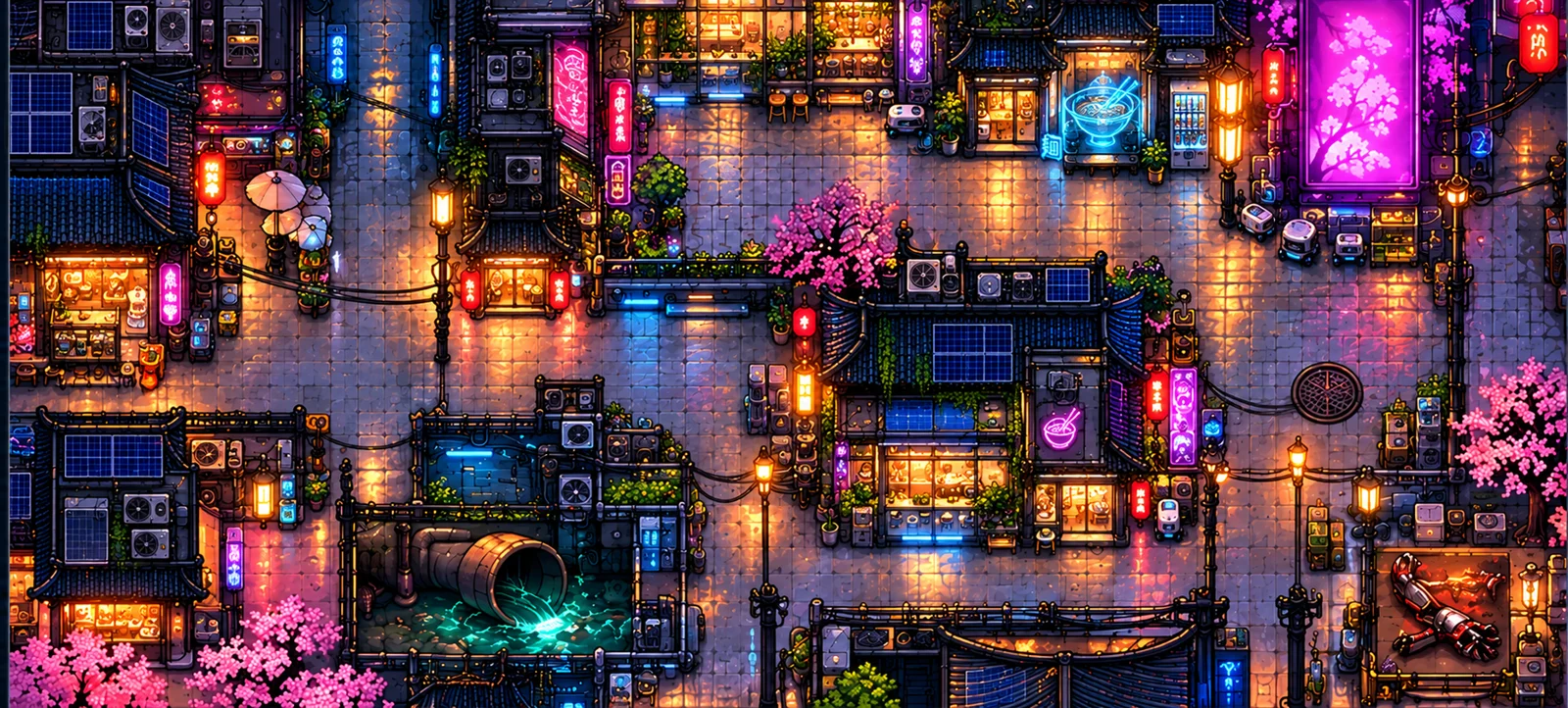
The central question was how to let a player feel the loss of a landscape without stopping exploration for a long explanation. The same street needed to communicate both the modern city and the forest the protagonist remembers.
The resulting loop is explore, sense, examine, remember, and grow. Qi Sight reveals another layer of the environment; examining an object brings its memory into the present; a growing jade leaf gives progress a form that belongs to the story.
Narrative choice: a river inside a pipe
At a rusted pipe, the player can listen to the buried river or turn away. The GDD specifies that listening reveals a jade sprout and awards a full memory contribution; turning away makes the city louder and awards half. Both routes continue the story.
The choice carries forward through a river_alive flag. In Mission 02, the protagonist either recognizes the river he trusted or revises his belief that remembering would be enough. A small branch therefore affects environment, progression, sound, and character interpretation without requiring two separate missions.
A tradeoff remains: the two emotionally valid responses receive different amounts of growth. That may make the mournful response feel like a penalty. Player testing should establish whether that difference supports the intended tone or undermines the choice.
Environmental guidance and pacing
Mission 01 allows three memories to be found in any order. Mission 02 uses a sequence of encounters along a spiritual root visible through Qi Sight. This changes the pacing from open discovery to a more directed reveal while keeping navigation inside the fiction.
The dead tree, shrine echo, night-shift worker, and living root have different narrative functions: recognition, remembrance, outside confirmation, and revelation. The worker reacts to a tremor, giving the supernatural event a witness beyond the protagonist.
The early exit into Mission 02 is an important edge case. Skipping Mission 01 removes the river callback and changes leaf growth. Before treating this as a polished onboarding flow, I would test whether players understand the transition or accidentally miss the choice.
UI and production iteration
Three UI directions were explored: ink and paper, a cyber terminal, and a hybrid. The final GDD combines a dark jade panel with calligraphic accents so dialogue can remain legible against neon environments while retaining the protagonist’s identity.
The production log records rejecting low-resolution overlays, replacing inconsistent environment assets, preserving gameplay geometry during art swaps, and removing a planter that blocked a passage. These are useful examples of reviewing generated output against a design goal and resolving visual and navigation problems.
The GDD describes reusable interactables, mission directors, and signals connecting dialogue, memories, and progression. These explain the intended system structure; the exported build is not sufficient to audit source-code quality or claim independent programming ownership.
Revision 1 · October 1, 2026
I revised the prototype in three connected areas: the Cultivator’s dialogue, the visual treatment of memories, and the transition between music, rain, city noise, and nature. The goal was a clearer character voice and a more coherent experience across both missions.
Dialogue: clarity and character voice
Five identified lines changed. The prologue now emphasizes the forest; the pipe scene removes an extra declaration; the dead-tree description combines two short lines and changes “know mine” to “remember me.” The shrine introduces “an older woman” before referring to her as “she.” These edits focus the theme, tighten the phrasing, and give the player a clearer referent.
Memories: a shared visual language
Mission 02 now reuses Mission 01’s ghost landscape and mist at their original scale. Local overlays sit around memory locations rather than stretching one image across the larger district. Redundant gateways, leaves, and shrine layers were removed; the shrine keeps one bright lantern-shrine image. This reduces competing imagery and makes each memory read as part of the same world.
The shrine memory now remains active during its conversation. The dead tree and shrine use a stronger city veil than the final forest memory, supporting distinct moments within one consistent effect.
Sound: transitions that carry the story
Music carries from the title into the prologue, then gives way to rain as play begins. Rain continues across the two missions; memories lower it to about 20%. Mission 02 adds traffic, positional neon glitches, and a hum that strengthens near the train line. Its memories remove the city noise and keep a quiet river, while birdsong is reserved for Mission 01’s memories.
This creates a deliberate contrast: the city is loudest near the living root, where the forest is closest. The revision notes report replacing generated placeholder sounds with licensed recordings, preparing seamless ambience loops, and converting the music source to OGG for the build.
Review and remaining decisions
The dialogue pass used stable line IDs, exact replacements, backups, and checks that expressions remained aligned. The revision notes report reviewing the dead-tree, shrine, forest-memory, and train-line Qi Sight scenes in Godot. Integration checks confirm the new dialogue text and new mist and audio assets are present in the exported pack; they do not replace a full browser playthrough.
Three questions remain: the river painting and the following pronoun need review after the prologue’s shift to the forest; the worker exchange needs a decision about whether the Cultivator is deflecting; and one spirit tree away from a memory location may need to be removed. These are recorded as next-pass decisions, not completed changes.
Download Revision 1 notesOutcome, limits, and next evaluation
The deliverable is an exported browser prototype and a design case study. Packaging checks verified the required web files, referenced payload sizes, and byte-for-byte reconstruction of the files used for hosting. A full browser playthrough and player study have not been completed as part of this portfolio integration.
The supplied GDD reports no disk save, no return from Mission 02 to Mission 01, and a missing worker portrait. Session length, navigation clarity, readability, and emotional impact have not been measured with players. I would evaluate both river routes, accidental early entry, and whether players can follow the roots without additional instructions.
Design documentation
The original Claude-generated GDD is included as a development reference. Its image placeholders and reported behavior are retained as supplied; they are not additional verified results.
Download original GDD (English)