Review
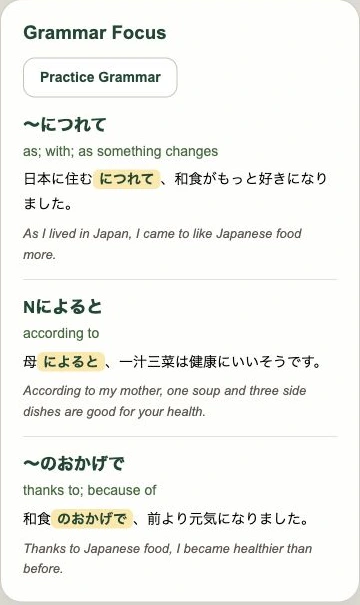
Use a short grammar reference alongside chapter activities.
 Selected work
Independent project · Interactive learning · AI-assisted development
From recognizing a word to using it.
A chapter-based practice companion inspired by my experience studying 食で考える日本社会.
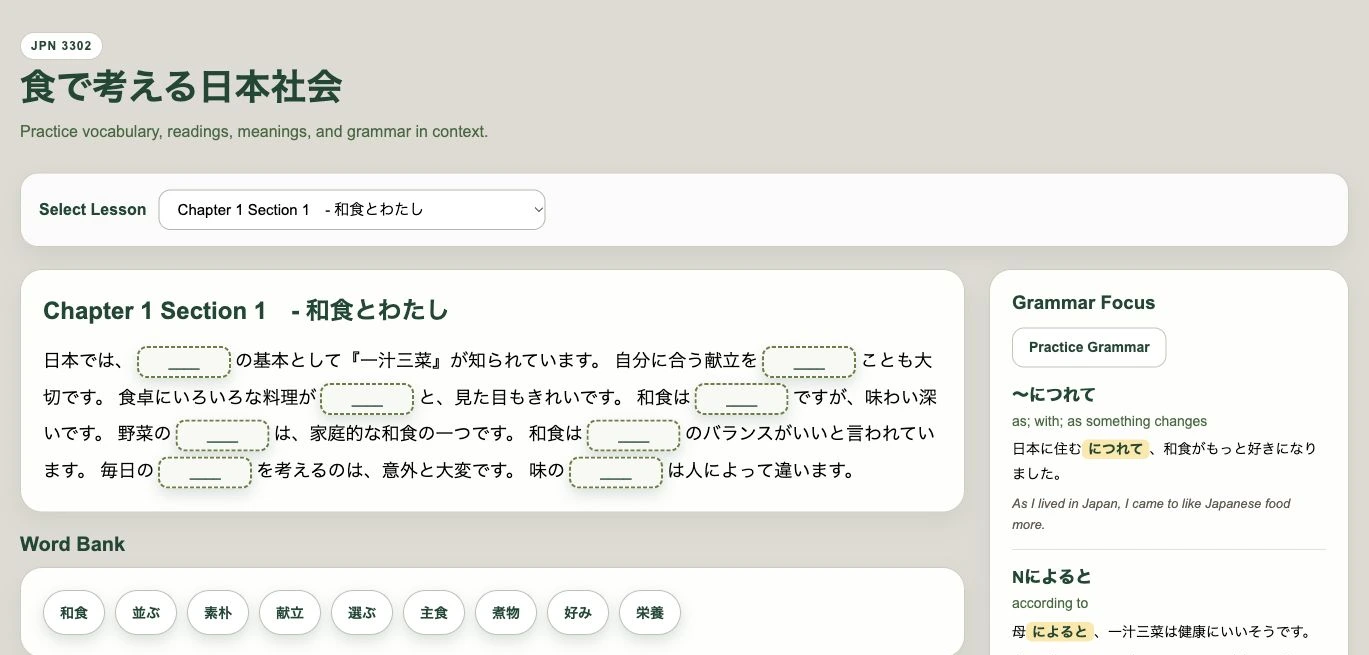
I started this independent prototype in April 2026, toward the end of the semester, using my own experience studying 食で考える日本社会 as the starting point. Recognizing kanji did not always mean I could recall the reading, explain the meaning in English, or use vocabulary and grammar in context.
The design brings mock quizzes, kanji-reading practice, English meanings, and short grammar references into a chapter-based companion. The aim is to make repeated practice easier to approach and connect recognition with active recall.
During my Japanese course, our instructor typically assigned about 20 vocabulary words before a quiz, but only around 10 appeared in the assessment. We needed to understand their meanings, remember the hiragana readings, and apply them within passages from 食で考える日本社会.
Recognizing individual kanji was often easier for me than recalling and applying vocabulary in context. With limited opportunities to practice the assessment format outside class, I wanted a way to work through the entire vocabulary pool.
How could I create additional opportunities to practice the entire vocabulary pool, rather than memorize one fixed set of quiz answers?
Use a short grammar reference alongside chapter activities.
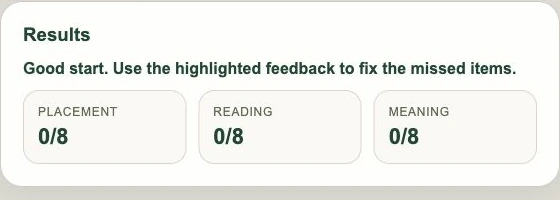
Enter hiragana readings and English meanings instead of only recognizing an answer.
Three additional quiz rotations vary vocabulary combinations for repeated practice.
The original design combined mock quizzes modeled on classroom assessments, hiragana-reading and English-meaning practice, and short grammar references. After implementing the initial chapter quizzes, I expanded the experience with three additional quiz rotations using shuffled vocabulary selections. These provide varied combinations for additional practice; they are not four permanently fixed quizzes.
One repeated quiz could encourage memorizing answer pairings and order.
Add three rotations with shuffled vocabulary selections.
Encourage broader recall of meanings and readings across varied practice combinations.
I began this exploration of AI-assisted coding in April 2026, working with ChatGPT and Codex in Visual Studio Code. I typed out the chapters and supplied the supporting vocabulary lists, text, and a sample quiz paragraph from class. These references gave the AI the content and context it needed to build activities around the learning goals.
I supplied the content, subject knowledge, concept, and proposed solution; AI generated the code that made the experience functional. My role was to guide that implementation, review how the activities worked, and refine the result against the learning intent. The design remained human-led throughout the co-building process.
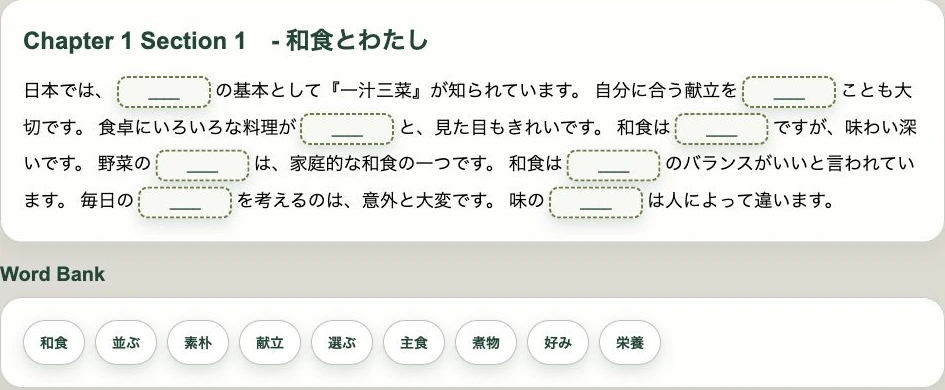
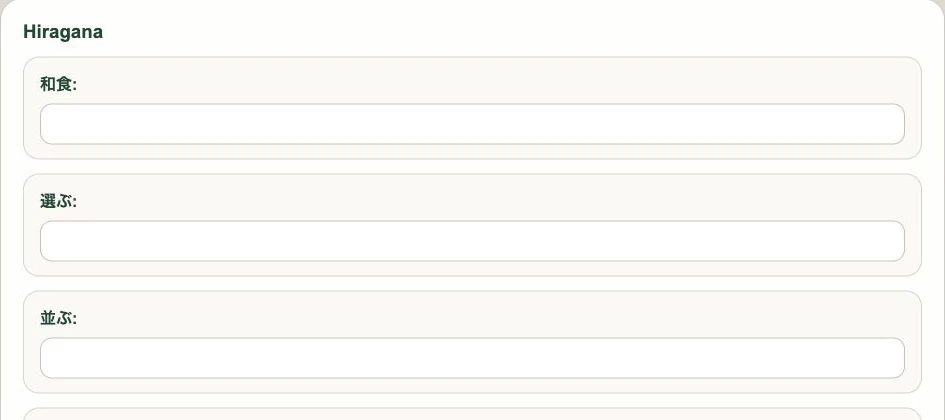
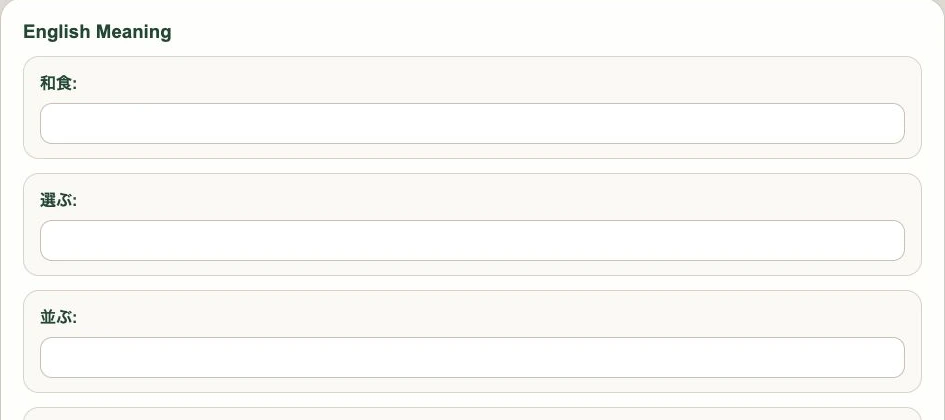
This was my first experiment with vibe coding, using ChatGPT and Codex in Visual Studio Code. Before development began, I had already defined the instructional problem, initial activities, and intended experience. The biggest challenge was expressing that vision clearly and precisely enough for the AI coding assistant to implement it.
I provided the instructional concept, learning content, subject knowledge, and creative direction; AI generated the implementation code. I directed development and reviewed the resulting interactions. Having a clear vision was different from communicating it effectively: the experience taught me the importance of precise instructions, defined requirements, iterative review, and human judgment.
After developing the application in April 2026, I demonstrated it to my team as an example of what AI-assisted development could produce. The experience helped shape how I now build interactives: human-led instructional design and creative direction supported by AI-generated implementation.
I also shared the prototype with my former Japanese instructor. It remains an independent prototype; classroom adoption is not confirmed. The learning benefits described here are design intentions, without student-testing results or measured learning outcomes.
Try the chapter-based activities in the live prototype, or explore the source repository for the implementation.