End-to-end experience design
Concept, learning design, conversation flow, Figma wireframing, Storyline production, AI integration, accessibility planning, and peer-test refinement.
 Selected work
Interactive learning · conversational AI · 2025
A focused, accessible conversation that helps faculty reflect on inclusive course-design decisions—without letting the technology overshadow the learning.
The prototype opens in Articulate Review in a new tab. The experience is in English; this case study is available in English and Japanese.
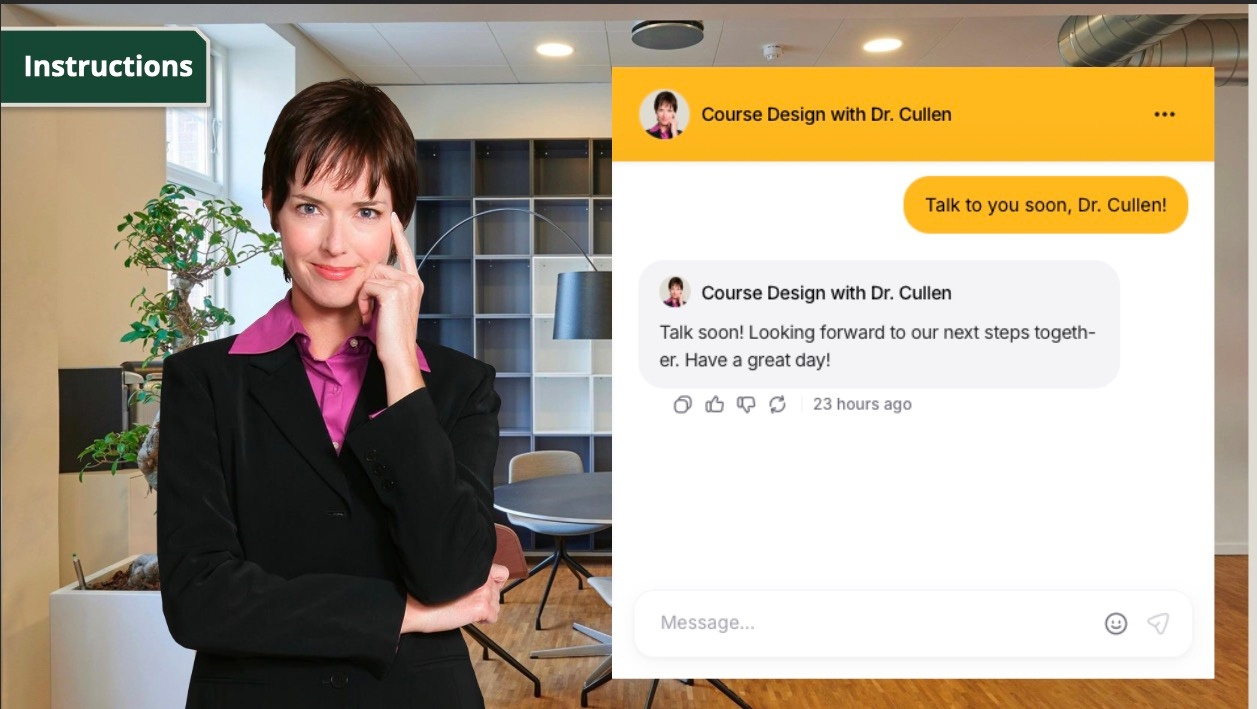
I designed and built this capstone for the Certified Digital Learning Professional Immersive Learning pathway. The brief was to create an immersive experience that supports faculty as they consider Universal Design for Learning and inclusive course creation. Instead of presenting another checklist, I used a mentor character—Dr. Cullen—to turn abstract guidance into a reflective conversation.
Concept, learning design, conversation flow, Figma wireframing, Storyline production, AI integration, accessibility planning, and peer-test refinement.
Articulate Storyline provided the accessible shell; an embedded Chatbase assistant made the conversation responsive without requiring a learner login.
Completed through backward design in three phases: prototype, production, and peer testing with targeted refinements.
The flow gives the learner enough context to act, then lets the conversation carry the experience.
The office setting and Dr. Cullen establish a supportive, professional frame.
The learner decides which course-design idea they want to explore.
The embedded AI responds within the selected scenario and prompts deeper thinking.
The exchange closes with a concise summary and actionable direction.
The pivotal UX decision
The first concept used a more elaborate 360° space. Testing showed that its extra layers competed with the activity that mattered: the conversation. I replaced it with a single-screen layout that keeps Dr. Cullen as a visual anchor, the chatbot central, and instructions available in a slide-out panel.
That restraint reduced cognitive load, improved flow, and made the experience feel more coherent. The immersive quality came from agency and meaningful dialogue—not from adding spatial complexity.
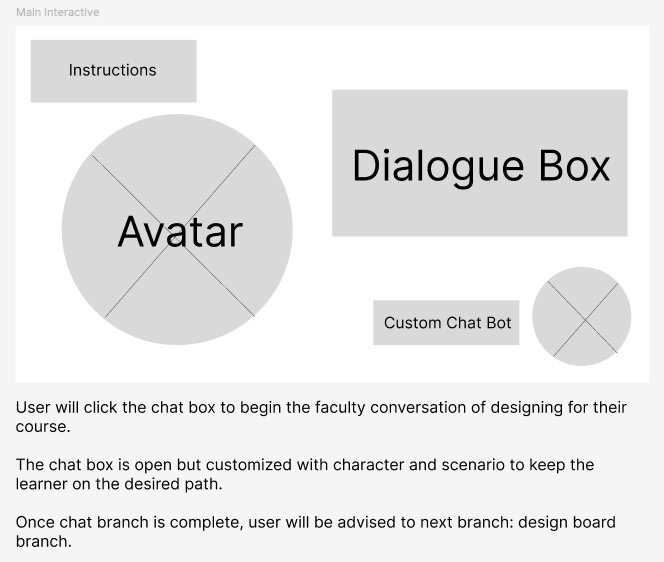
Large type, a simplified layout, and persistent visual anchors reduce the effort needed to understand what happens next.
Voiceover is limited to instructions, with an optional transcript and a path that does not depend on a VR headset.
The assistant prompts reflection rather than replacing human judgment. Transparency, privacy, and human review remain design requirements.
The work followed backward design: define the reflective decision first, then choose the technology that could support it. Storyline offered a familiar, review-ready shell; Chatbase made a custom conversation possible with a low-code embed and open access.
The result is a working Storyline prototype with an embedded AI mentor and a deliberately restrained interface. It demonstrates how conversational interaction can create presence and reflection without relying on a headset or a visually complex environment.
The next round of evaluation would test with faculty learners and measure navigation clarity, the usefulness of Dr. Cullen’s prompts, and whether learners leave with a concrete change they can make to a course. Future iterations could add adaptive branching based on tone or keywords and connect interaction analytics to an LMS.
Open the live prototype to meet Dr. Cullen and explore the course-design dialogue.
Launch live interactive